
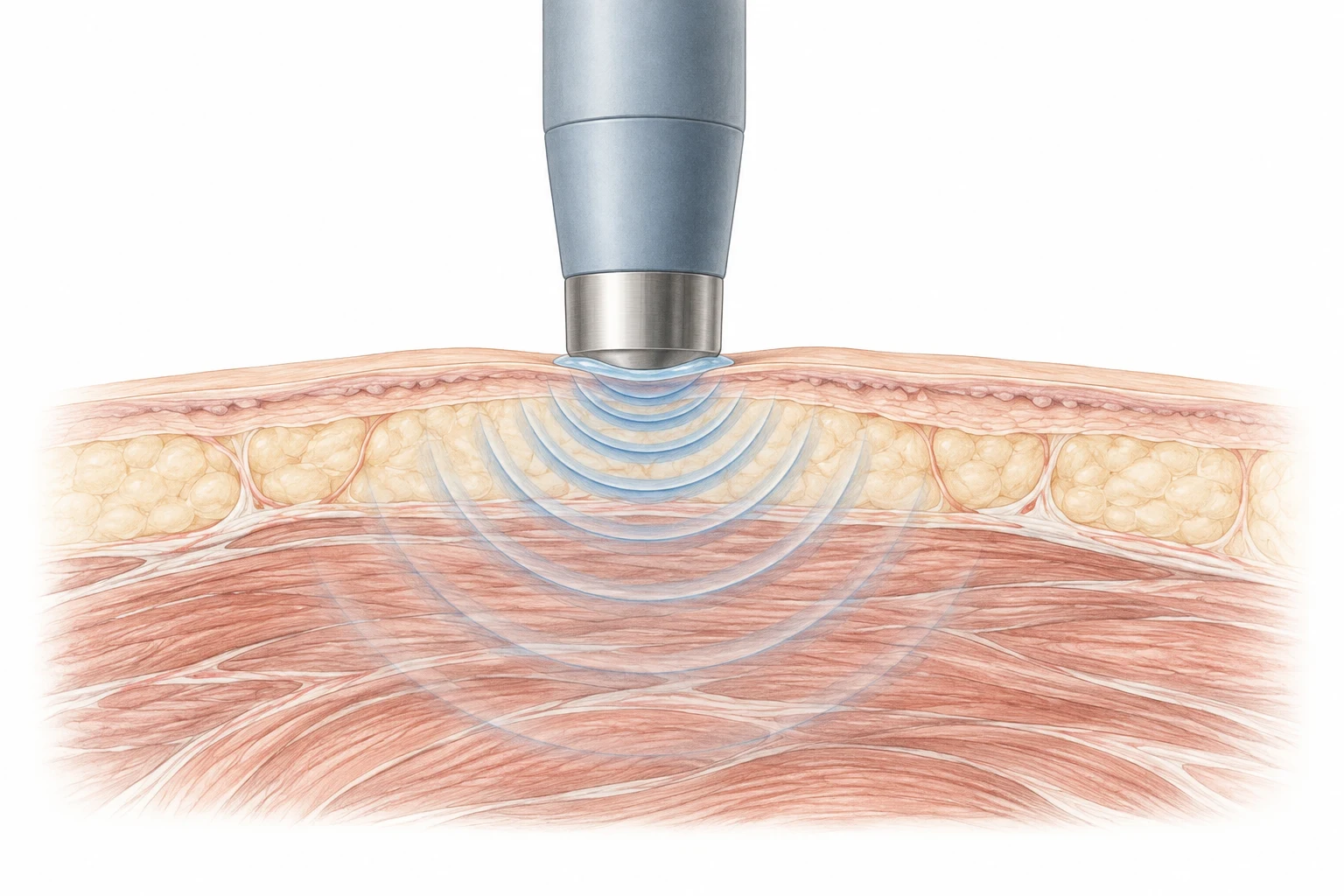
- Handpiece
- Treatment head
- Pressure waves
Mechanically cheerful
Compressed air accelerates a small projectile inside the handpiece. The projectile hits the metal treatment head and stays in the handpiece.
The head transmits the pulse
The collision is causing a mechanical pressure pulse. The treatment head passes it to the tissue via contact gel.
Distribution from the skin
The pressure waves spread out from the contact surface. Their intensity is highest there and decreases with distance and depth. They do not form a separate focal zone.
Technical explanation of the manufacturer (opens in a new tab) ↗
Another technique
Radial pressure waves are physically different from focused shock waves. The greatest pressure is generated near the applicator. That difference is relevant when choosing the treatment, but the choice depends on more than just depth.
When can radically fit?
Radial pressure waves are used for certain persistent symptoms of tendons and surrounding soft tissue parts. Whether the treatment is meaningful depends on the condition, the justification, previous care and your personal situation.
Radial shockwave for nerve problems
Also nerve problems are part of our focus area. We sometimes use radial shockwave as part of a treatment plan, after assessment of the cause and severity. The study includes mild to moderate carpal tunnel syndrome: a pinching of the middle hand nerve in the wrist. Those findings do not automatically apply to other nerve disorders.
What does the research on carpal tunnel syndrome say?
The 2026 APTA/JOSPT guideline mentions shockwave as a possible option in non-operatively treated mild to moderate carpal tunnel syndrome. The recommendation concerns symptoms and hand function in the short and medium term, less than six months; radial shockwave may be considered above focused shockwave. The AAOS guideline of 2024 does not find a proven long-term benefit. The results differ: a small study with a dummy treatment found additional improvement, while another study with 40 participants found no additional clinical improvement over a wrist splint alone.
A per-symptom balance
We discuss the purpose, the uncertainties and the other possibilities, such as a wrist splint, adjustment of load or assessment by a doctor. Shockwave does not replace necessary medical treatment. New or increasing strength reduction or loss of feeling is a reason to contact your GP first. When we propose radial shockwave, we agree in advance on how we assess the effect.
The treatment and your reaction
You feel rhythmic pulses on the skin. Temporary sensitivity, redness or bruising may occur. We discuss the possible side effects and evaluate your response during and after treatment.
No automatic combination
Focused and Radial, both are not used by default. A combination also requires a substantive reason and explanation about the expected added value.
This information is general. Whether shockwave is appropriate for you requires a personal assessment. There's no guarantee of recovery.
More about the evidence
A location in your area
Compare real practice addresses and travel from your hometown.
Find your region