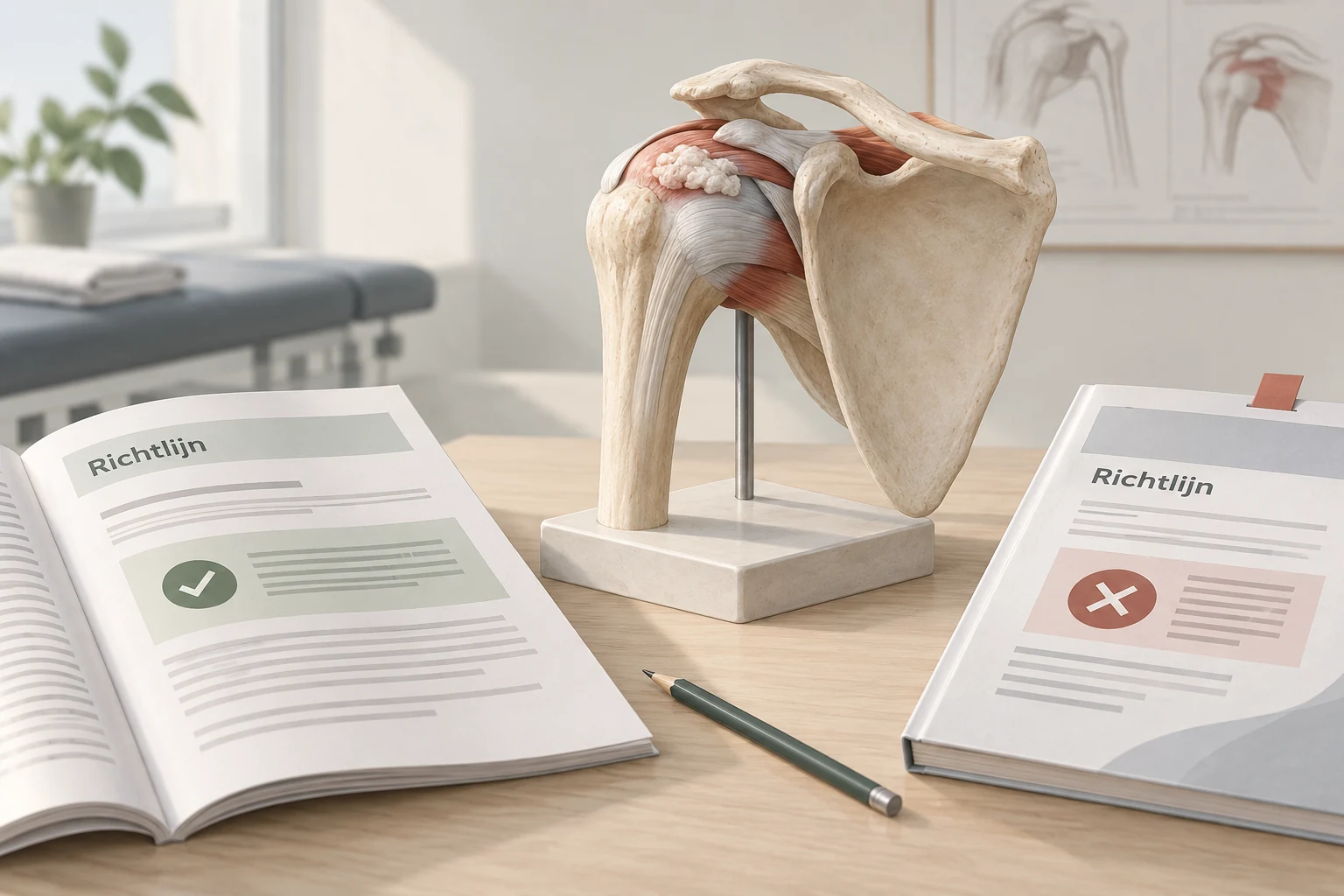
Two directives, two recommendations
Anyone looking for information about shockwave in shoulder calcification may encounter opposing advice. NICE does not provide sufficient evidence of efficacy and advises treatment only in a study. The international rotator-cuff guideline of 2025 calls shockwave as a possible treatment in calcitic tendinopathy.
Both entries belong in a balanced explanation. Only referring to the most favourable recommendation gives an incomplete picture. The opposite is true: a cautious guideline does not automatically mean that all the studies have achieved exactly the same result.
For you, it's most important that the clinic discuss the difference before you choose. An answer as we have good experiences does not replace an explanation about scientific evidence. Personal experiences cannot show what would have happened without the treatment.
Research looks at an extra effect
When people have less pain after treatment, it is not yet clear how much improvement this treatment brought. symptoms can change in time. Advice, custom activities and other care sometimes play a role. That's why good research groups compare.
A dummy treatment tries to make the conditions comparable without the same effective application. This is an important tool in examining procedures. It doesn't mean pain is imagined. It helps to assess what additional contribution a technique makes.
Also note the equation. Shockwave versus another active treatment answers a question other than shockwave versus a dummy treatment. If both groups improve, one option can hardly have any added value. That difference between change and extra effect is useful in reading success stories, percentages and graphs.
It's about your symptom, technique and outcome.
Shoulder pain is a broad collective name. Calcination, a full tear in a tendon and a stiff shoulder are not interchangeable. For example, the 2025 guideline explicitly distinguishes between rotator-cufftendinopathy with and without calcification. A positive conclusion in one group should not be used simply for the other.
The treatment should also be consistent. Ask whether a study used focused shock waves or radial pressure waves, which additional care was given and how long people were followed. Only the word shockwave is not enough to know that a proposal is equivalent to a researched approach.
Finally, what outcome has been measured? Less pain during a test, a better shoulder questionnaire and full work again are different outcomes. A small group difference can be statistically detectable without taking it for granted in your own life.
Why Directives may differ
guideline makers should make choices about the demand examined, the selection of studies and the degree of certainty required for a recommendation. The date of publication may also determine which investigations were included. These are general reasons why recommendations can differ; without a comparison of the full assessment methods, you cannot tell what reason is decisive here.
Therefore, do not use the year as a simple ranking. Newer information deserves attention, but it does not automatically get stronger because it appeared later. Conversely, an older recommendation should not remain unspoken when it is still actively published.
A trader can explain which data are relevant to your consideration and where uncertainty remains. In the case of surgery or paid series of treatments, this is information that is required in advance. You don't have to solve the debate between researchers yourself.
A call card to check claims
Bring the following questions when shockwave is proposed. You don't have to put them all literally; choose the points that are still unclear.
| Claim you hear | Question that makes the proposal concrete |
|---|---|
| It works in shoulder pain. | Has my type of shoulder symptom been investigated? |
| It breaks down lime | What improvement in pain or function do we expect? |
| A lot of people are getting better | What was the difference with the comparison group? |
| You need multiple sessions | When do we evaluate and when do we stop? |
| The latest technique is better | What comparison does that support? |
For example, your main goal is to do another job above shoulder height. Then a photo with less lime is not alone enough to call the goal achieved. Precisely how you're going to follow that task. This makes an abstract treatment assessment useful for your situation.
What do you do with uncertainty?
Uncertainty doesn't have to be a reason to postpone all care. You can choose a plan whose parts and boundaries are clear. For example, first explanation, an executable exercise plan and an evaluation of daily load, followed by a new conversation if improvement is not possible.
A choice of additional shockwave requires a separate consideration of potential benefits, inconvenience, costs and alternatives. A choice not to do so is also legitimate. You shouldn't experience pressure because equipment is available by accident or because a package has already been compiled.
Ask for a short summary of the reason for the treatment and the uncertainties. Keep it next to your own goals. If other symptoms develop or deteriorate during the course, a re-evaluation is more useful than automatically repeating the same treatment.
Frequently asked questions
Does insecure evidence mean shockwave never works?
No. Uncertain evidence means that the size and reliability of the extra operation are not sufficiently established. An individual improvement does not prove that effect, while an average research outcome is not a personal prediction either. That distinction is part of the explanation for your choice.
What exactly does NICE advise?
NICE advises shockwave in calcified shoulder tendondinopathy solely in research due to insufficient evidence of efficacy. That's stronger than just saying that the outcome differs per person. A proposal in daily practice should discuss this opinion fairly.
Is delimination a good endgame?
It may be a research outcome, but it doesn't fully explain how you function. Also arrange a daily goal, for example sleep or reach out. Ask why any new imagery is needed and what the result would change to the sequel.
Can I postpone a treatment proposal?
You can ask for time to understand the information and discuss alternatives. Ask what care you can continue in the meantime and whether delay in your particular situation has disadvantages. In case of sudden new symptoms, a medical assessment is a different question than choice of shockwave.
Sources and evidence
- NICE: shockwave when calcification of a tendon in the shoulder (2022) ↗
Study advice and insufficient efficacy in calcified shoulder tentinopathy.
- Rotator Cuff Tendinopathy: Clinical Practice Guideline (2025) ↗
Shockwave may be considered for calcific rotator cuff tendinopathy, but is not recommended for non-calcific rotator cuff tendinopathy.
A personal follow-up step
From insight
to an appropriate plan.
At a paid intake, we'll discuss your symptom and do targeted research. ultrasound is included at no extra cost when it makes sense. Any treatments are agreed separately.
View the initial consultation