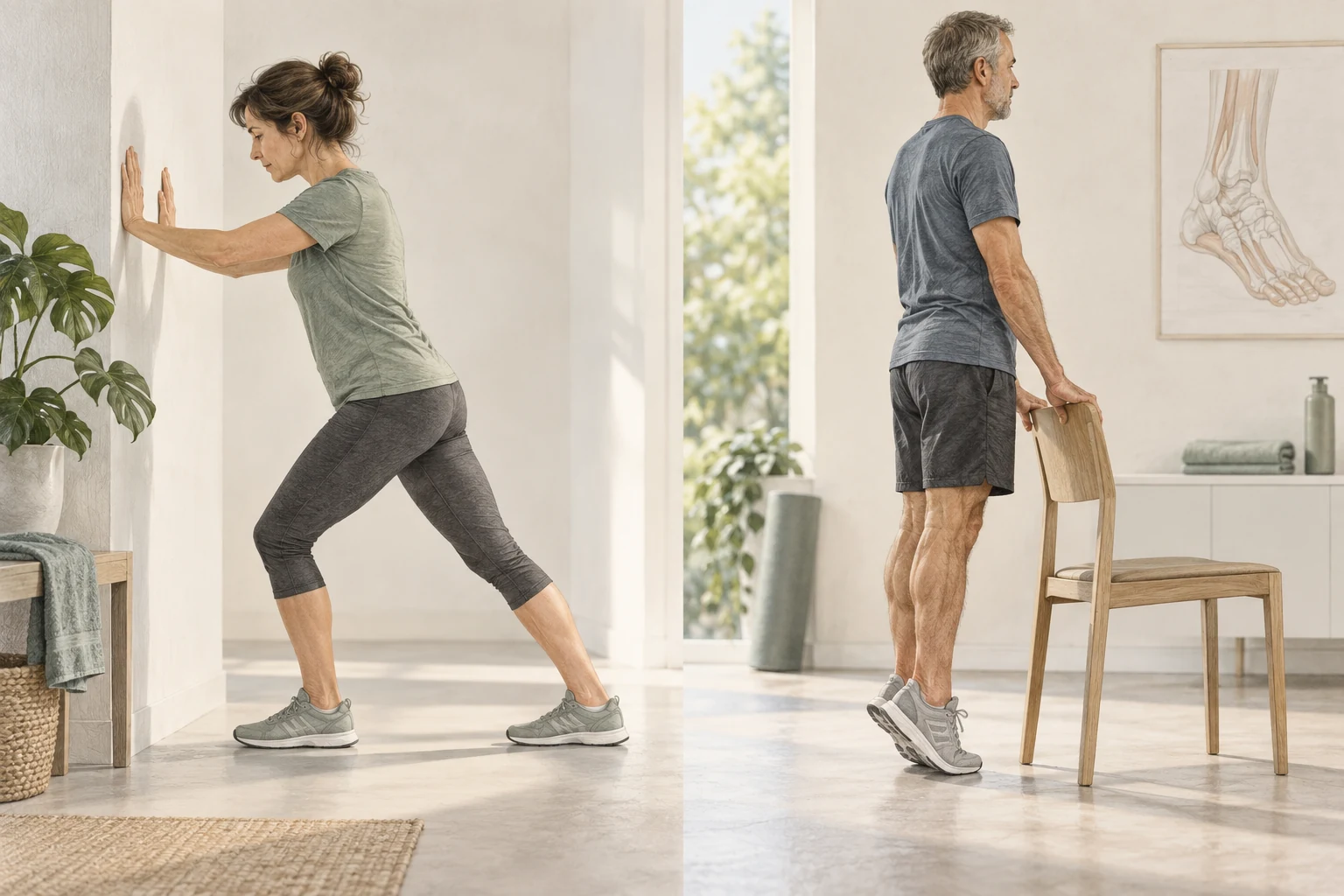
Two practice goals that you can keep apart
Stretching and strength training require something else. With racks, a chosen movement position is central; in strength training, the muscle-tear chain provides strength against resistance. In a training plan, the emphasis may vary. That does not mean that everyone needs both parts in maximum quantity or that one of the two always solves the cause.
Start with the question of what you want to improve. More trust in the first steps, longer standing or return to running are different goals. An exercise is only well chosen when it is clear how it fits within that goal and how you follow the reaction. Only the name of the practice method says little about the right load for an individual foot.
What do guidelines and research advise?
The Dutch guideline on Practice Therapy recommends a joint choice for stretching exercises or constructive strength exercises, with attention to preferences, daily activities and persevere. It describes a training period of at least 12 weeks. That's a treatment period to work with, no guarantee that symptoms will disappear afterwards.
In a randomised study of Rathleff and colleagues racks and strength training were compared in people with fasciitis plantaris; both groups also used insoles. The strength group had more favourable self-reported results after three months. Such a study supports a possibility, but does not prove that the controlled schedule without adjustment is suitable for each patient or that one component explains all the effect.
Feasibility determines whether the plan really exists
An exercise can fit perfectly on paper and is not feasible in everyday life. Think of insufficient time, balance problems, insufficient space or a working day that already weighs the foot heavily. Report those restrictions. A more realistic alternative is more useful than starting over and over again on a program that you cannot sustain.
Also ask whether the implementation is clear enough. How slowly do you move, what support can you use and what range is intended? A short movie might help you remember, but doesn't replace an explanation about your boundaries. The clinician should be able to indicate how to make an exercise easier or heavier and when to contact them.
Assessing the reaction is more than pain during one repetition
Watch what happens during the exercise, how you move and how the heel reacts later. Avoiding pain completely is not necessary for everyone; ignoring sharp or clearly rising pain is not a general rule either. Make personal agreements about an acceptable response and about what you do when it is exceeded.
A think example: an exercise feels reasonable during the session, but you start to walk shorter and shorter the next day. Then the whole thing has to be looked at. Perhaps the exercise load is too high, perhaps it coincides with extra standing at work. Do not automatically reduce or increase all parts at once. A targeted change makes the evaluation easier to understand and helps avoid unnecessary back-and-back switching.
Compare a plan on these practical features
| Question | On stretching | In strength training |
|---|---|---|
| What's to be clear? | Position, target area and feeling during posture | Performance, resistance, range of motion and recovery space |
| What can limit feasibility? | Hard to reach posture or irritation at stretch | Balance, material, total daily load or too heavy start |
| How do you follow your usefulness? | Does the exercise fit and alter the functional purpose? | Can you repeat the chosen load and build it appropriately? |
The table is not a recipe and does not prescribe sets or repeats. She helps to ask questions before you run a schedule. Please also note why this training form has been chosen. In an evaluation you can then return to the original consideration, instead of adding a new internet exercise each time.
When is adapting wiser than working harder?
Please review the program when the execution remains unclear, the response becomes structurally less favourable or the exercises do not match what you want to resume. Also missing progress after a seriously executed journey requires a conversation. That conversation can be about load, therapy, expectations or diagnosis; it doesn't have to lead to an additional technique immediately.
Take a brief overview of what you really did. Honestly indicating that an exercise failed is more useful than trying to report an ideal schedule. You don't have to prove every day that you're motivated by more repetitions. A careful plan also includes calmer moments, a clear follow-up step and space to adapt exercises to your circumstances.
Frequently asked questions
Can I only stretch if strength training hurts too much?
That may be a discussable option, but first let's see why the strength training doesn't fit. The starting load, execution or total day can be adjusted. Also stretching is not automatically symptoms-free or suitable; together choose an executable alternative.
Does a stretcher have to pull hard to work?
More stretching doesn't automatically mean more effect. The intended position and reaction must be clear. Do not force sharp pain or posture that causes more permanent discomfort afterwards. Ask which sensation and dosage are appropriate to your exercise goal.
Is heavy training proven to be better for everyone?
No. A study result in a selected group is not a universal requirement. The study design, comparison treatment and baseline count. The Dutch guideline leaves room for different training choices that are coordinated and evaluated.
When can the exercise get heavier?
If the current load and daily activities are sufficiently repeatable, construction can be discussed. Look not only at the last repetition, but also at functioning and the reaction afterwards. The appropriate moment and the size of the step vary per person.
Sources and evidence
- guideline Fasciopathy plantar — Practice therapy (2026) ↗
Reclining or strength training as a joint choice and evaluation after sufficient exercise period.
- Rathleff et al. — High-load strength training in plantar fasciitis (2015) ↗
Randomized comparison of strength training and racks, both with insoles.
A personal follow-up step
From insight
to an appropriate plan.
At a paid intake, we'll discuss your symptom and do targeted research. ultrasound is included at no extra cost when it makes sense. Any treatments are agreed separately.
View the initial consultation