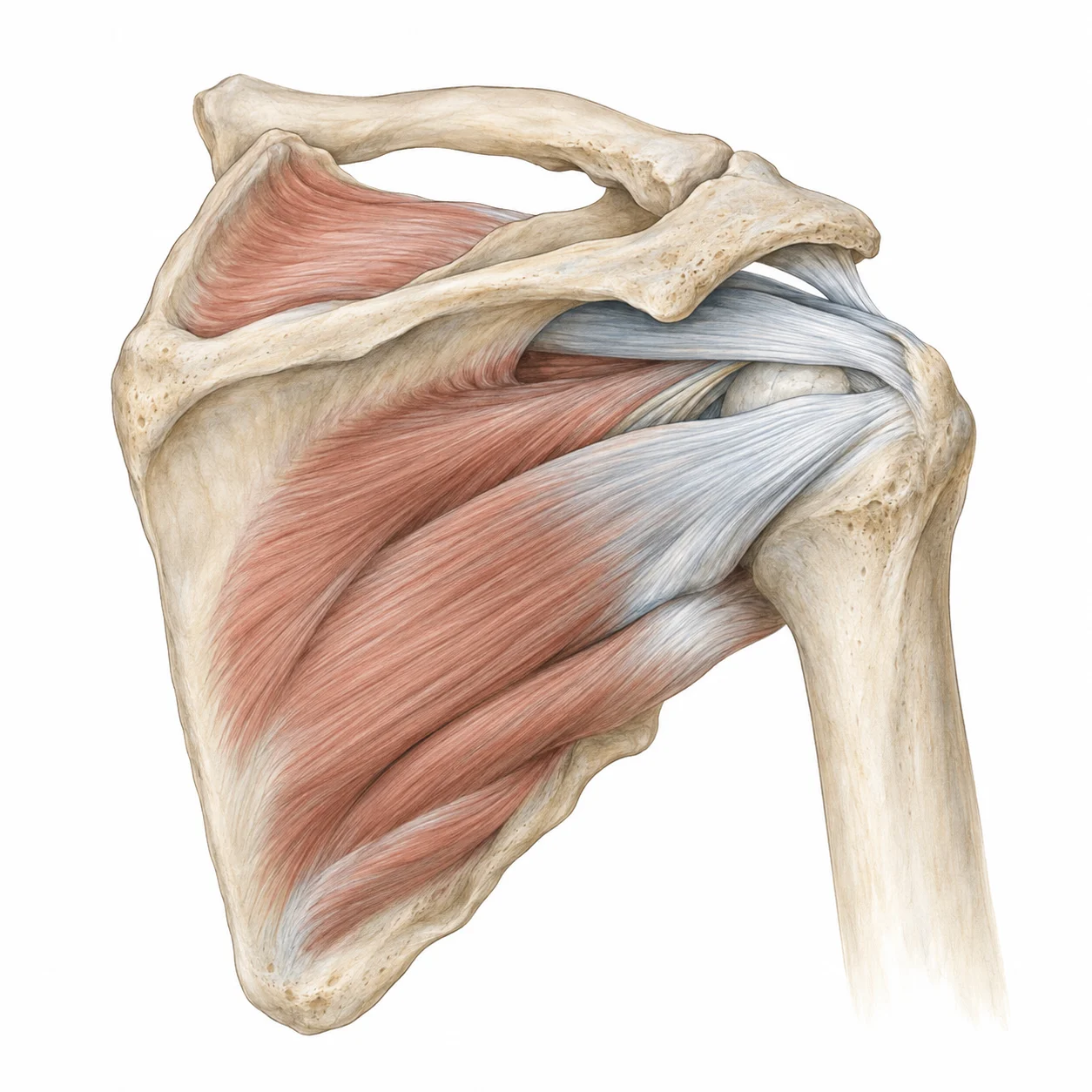
What is meant by the rotator cuff?
The rotator cuff consists of four muscles and their tendons around the shoulder joint. They work together when you carry a bag, rotate your arm or reach overhead. Tendinopathy describes pain and reduced function that may involve a tendon. The term alone does not determine which treatment is needed. The international guideline from 2025 discusses rotator-cufftendinopathy with and without calcification, and partial cracks. A complete crack is outside that specific guideline.
The most important thing for your conversation is what you can and cannot do. Can you lift the arm, but does that hurt? Do you barely get higher with help? Did the problem start after a fall? Those are different starting points. A general search term on the internet cannot judge those differences.
Why a painful movement is not a complete diagnosis
Pain on the outside of the upper arm and difficulty reaching adjust to shoulder discomfort, but do not indicate exactly one structure. Also your neck, a stiffer joint or other shoulder problems can play along. According to Thuisarts Therefore, the GP investigates the possible and painful movements and looks at the neck.
Don't compete with special shoulder tests at home. Trying a painful arm levy over and over again gives little new information. Rather describe one identifiable situation: putting on a coat, taking a cup out of a closet or helping a child dress. Note whether the movement, weight or duration is difficult. This way the clinic gets a concrete picture without you having to decide which tendon it is.
When an ultrasound can add something
In the case of newly-emerged shoulder symptoms without an accident, an ultrasound often does not change the policy immediately. An image can also show changes that do not explain why pain exists right now. Both the international guideline and the Thuisarts therefore focus on clinical studies before routine imaging.
Ask three questions with a proposed ultrasound: what uncertainty do we investigate, what possible outcome do we expect and what changes will the plan take? That helps to use an investigation meaningfully. After an accident with sudden loss of power, in case of an unclear pattern of symptoms or in the absence of progress, the consideration may be different. That requires assessment; a fixed rule like each shoulder should not fit an ultrasound.
A report is only complete when someone connects the findings to your movements and goals.
An active plan that fits into your week
An individual training programme is, according to the guideline, one of the first possibilities. That can consist of exercises for control and strength, tailored to your capabilities. There is no universal weight or number of repeats that each painful shoulder needs. A light exercise program can also be clumsy if it comes on top of a hard working day.
So start the consultation with your whole week. When have you been using the shoulder a lot? What task can you temporarily modify? Which exercises can you perform independently and what explanation is still missing? A plan with few clear parts can be more executable than a long list that saves you only on days off. Show how you practice when you doubt the execution.
Make an appointment in advance about evaluation. Discuss what an acceptable response is for you and what change you contact.
Create your own shoulder card
This tool is meant to structure your conversation, not to diagnose it. Fill it out for two or three normal days.
| Component | What are you writing? |
|---|---|
| Main task | What do you want to be able to do? |
| Current implementation | With what weight, what height or how much help can we get? |
| Response | What do you notice during the task and later? |
| Possible adjustment | Can you reach lower, work shorter, or divide the weight? |
| Request for treatment | What step is needed to build this task? |
For example, cleaning out the dishwasher doesn't work, putting up a stack of plates high doesn't. That tells me more than just my shoulder is six in ten. You can then choose whether to change the weight, the reach height or the quantity first. The map also makes visible when an improvement has meaning, although there is still some pain.
When are you going to have a re-evaluation?
A plan remains a working hypothesis. Please contact us if the movement clearly decreases, normal tasks become increasingly difficult or agreed adjustments prove not to be feasible. Also discuss pain that deeply disturbs your sleep. This is relevant information for the treatment plan and does not need to be implicitly accepted.
Have new symptoms assessed after a fall or a powerful moment, especially when you can't lift the arm properly afterwards. Should shoulder pain be accompanied by acute tightness, chest pressure or severe illness, rapid medical attention is needed; this does not fit in with an ordinary exercise demand.
A good evaluation ends with a concrete choice: continue the current plan, adjust the load, review the diagnosis or discuss further research. Only adding more and more treatments does not make an unclear plan clearer.
Frequently asked questions
Is rotator-cufftendinopathy the same as a tear?
No. Tendinopathy is a broader description of tendon-related pain and loss of function. A partial or complete tear is a separate finding. The meaning depends, among other things, on the origin, the research and what your arm can still do. The term alone does not determine treatment.
Do I have to spare my shoulder?
Keeping completely still is usually not the starting point for common symptoms of tendons in the shoulder. Search with your clinic for activities that remain feasible and adjust heavy or repeated painful tasks. Other arrangements may apply after an accident or in the event of a specific diagnosis.
Is shockwave a first choice?
In non-calcified rotator cufftendinopathy, the 2025 guideline does not recommend shockwave. In the case of calcification, directives differ in their recommendation. First, diagnosis, previous approach and uncertainties must be clear. Availability of a device is not a reason to use it.
How can I tell that a practice plan helps?
Compare the same meaningful task under similar circumstances. Look for necessary help, range, weight and response afterwards. A loose good or bad day gives less information than a pattern. Please agree in advance when you discuss the findings together.
Sources and evidence
- Rotator Cuff Tendinopathy: Clinical Practice Guideline (2025) ↗
Definition, clinical assessment, active practice and various shockwave recommendations to calcification.
- Thuisarts: My shoulder hurts ↗
symptom pattern, restraint with early imaging and daily movement.
A personal follow-up step
From insight
to an appropriate plan.
At a paid intake, we'll discuss your symptom and do targeted research. ultrasound is included at no extra cost when it makes sense. Any treatments are agreed separately.
View the initial consultation