Two questions that are not the same
Shoe pressure at the back of the heel and load during removal are different experiences. A shoe edge can irritate a sensitive area, while another sole shape or heel height changes the posture and settlement. Therefore, describe exactly what is unpleasant. A general advice to wear a higher shoe may miss the real demand.
In an appointment, take with you the shoes in which you experience most symptoms, or make clear what you use them for. Work shoes, sports shoes and shoes for daily walking have different requirements. An adjustment shall be useful in the relevant situation. A tool that feels comfortable in a test pair but does not fit in your daily shoe, has limited practical use.
What's a heel enhancement supposed to do?
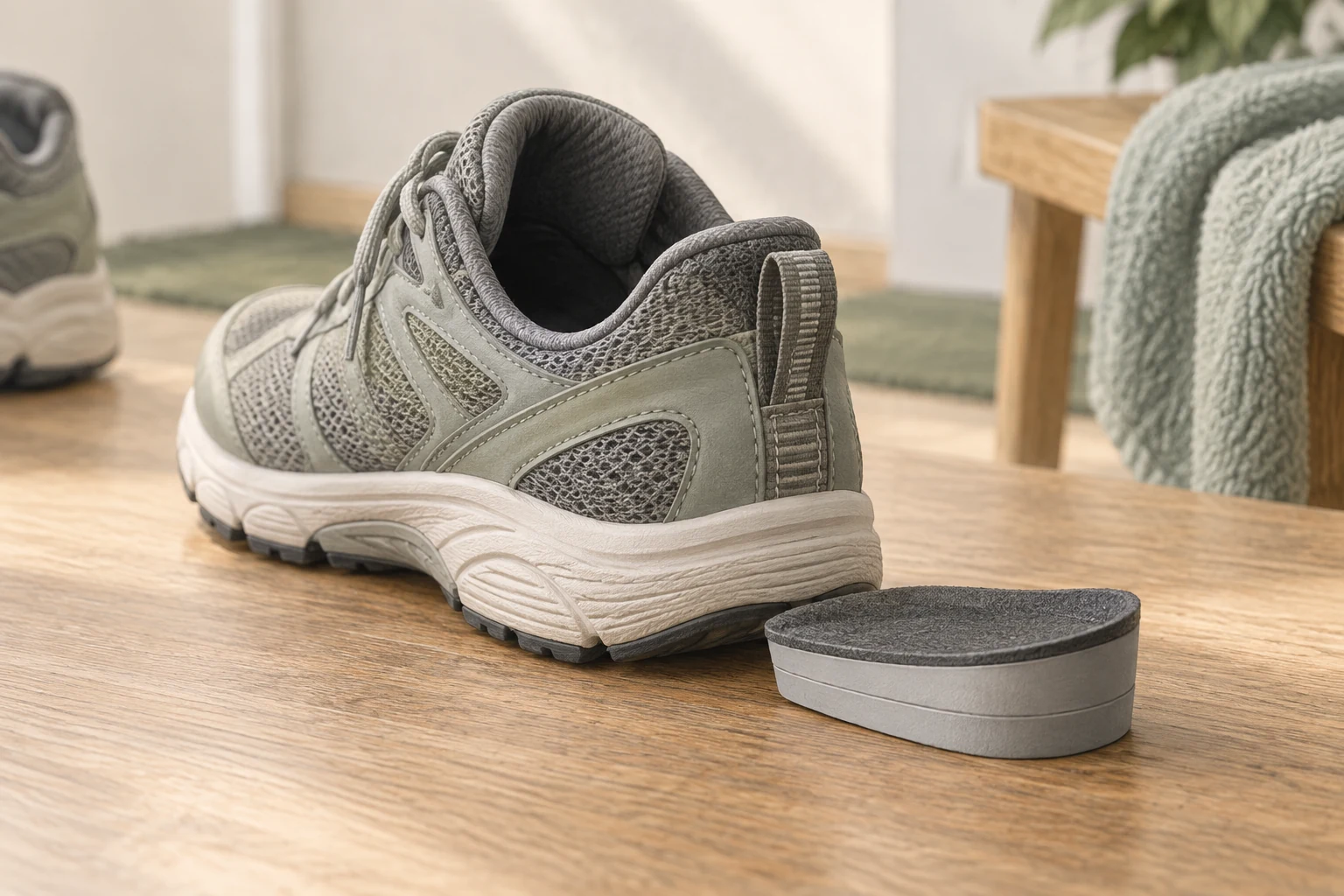
A heel elevation changes the position of the heel in the shoe. That may be a reason to try her temporarily, but the change is not automatically beneficial. The heel is also opposite the shoe edge and there can be less space left. The effect of the whole should therefore be considered.
Ask why an increase is proposed and what outcome is expected. Is it less busy, more pleasant walking or a temporary support alongside exercises? Without such a goal, it remains difficult to determine whether the adjustment adds anything. A higher increase is not self-evidently a stronger treatment and does not need to be stacked without advice.
Older and newer studies give modest expectations
The HEALTHY study compared heel elevation with eccentric exercises in middle part symptoms. There was an average benefit for the increase after 12 weeks, but the difference did not reach the predetermined limit for clinically important benefit. That makes a general promise difficult.
The LIFT study from 2025 Compared heel elevation to sham intervention. The mean pain benefit was small and potentially not meaningful to the patient; the researchers do not support primary treatment based on this. These studies are also about middle-piece symptoms. The results are not automatic support for any type of pain at the attachment.
Look at the complete shoe combination
Check space, stability and connection around the heel. An increase that pushes the foot forward may cause discomfort elsewhere. Also existing insoles count. Let us assess whether parts fit together rather than consider them to be beneficial independently. In case of reduced feeling or fragile skin additional control of pressure points is relevant.
One example: you have less tension during walking, but the heel rubs through the new position against the shoe edge. Then the combination should be re-evaluated. Only the first positive feeling is insufficient. The aim is a useful improvement in total activity, without a new problem destroying profits.
Make trying a clear trial
A simple trial appointment may consist of:
- The concrete goal, such as more comfortable walking a fixed daily route.
- The shoes and conditions in which you use the tool.
- The other treatments and activities that remain the same for the time being.
- The responses you contact earlier.
- The moment when continuing, adjusting or stopping is discussed.
Do not directly change training size and exercise resistance. Otherwise it is difficult to distinguish the effect of the increase. Please briefly note how you are going to walk and whether you are creating new pressure spots. An expensive tool does not need to be a better test; ask for costs, adjustment and follow-up checks in advance.
The tool is part of the broader recovery plan
When the increase gives comfort, it does not mean that the tendon can handle all the load again. Practice building and sport resumption require a separate consideration. On the other hand, a tool does not need to be continued if it no longer serves a clear purpose. Discuss how use can be adjusted when you change functioning.
For permanent symptoms it is important to look again at the diagnosis and daily burden. Buying other shoes or larger increases can maintain an unclear demand. A careful advice therefore identifies both the possible practical profit and the limitations of the evidence. You don't have to keep using a product just because the name suggests a logical mechanical explanation.
Frequently asked questions
Is a heel enhancement proven to be better than practice?
That general conclusion is too strong. An earlier study found a limited difference from eccentric practice; a more recent sham-controlled study showed only a small potential benefit. The results do not support a universal replacement of an active approach by a heel increase.
Can I increase the increase myself?
That is not a good overall strategy. The shoe fit and load can change in several ways. Ask which height and application are intended and have new pressure, instability or other symptoms assessed before you adjust further.
Should a heel increase in both shoes?
The appropriate application depends on the product and the individual advice. Do not improvise on the pain side alone. Ask explicitly how to use the increase and how to check the combination with existing shoes or soles.
Can I keep exercising with it if it hurts less?
Less pain can be pleasant, but does not give automatic permission for all sports load. Also follow functioning and the reaction afterwards. Let the build-up of tempo, duration and frequency connect to the agreed plan, regardless of the comfort advantage of the tool.
Sources and evidence
- Rabusin et al. — The HEALTHY trial (2021) ↗
Comparison heel elevation and eccentric exercise in middlepiece symptoms, with uncertainty about clinical significance.
- Bourke et al. — The LIFT Trial (2025) ↗
Small possible pain advantage over sham, under predefined limit for relevant difference.
A personal follow-up step
From insight
to an appropriate plan.
At a paid intake, we'll discuss your symptom and do targeted research. ultrasound is included at no extra cost when it makes sense. Any treatments are agreed separately.
View the initial consultation